
What does the 2026 Social Security Trustees Report Mean for the Future?
Social Security is not projected to disappear. However, the 2026 Trustees Report makes clear that the program’s current income structure will not be sufficient to pay all scheduled benefits indefinitely.
Social Security includes two legally separate programs:
- Old-Age and Survivors Insurance, or OASI, which pays retirement and survivor benefits.
- Disability Insurance, or DI, which pays disability benefits.
The combined programs are commonly referred to as OASDI.
 What problems does Social Security face?
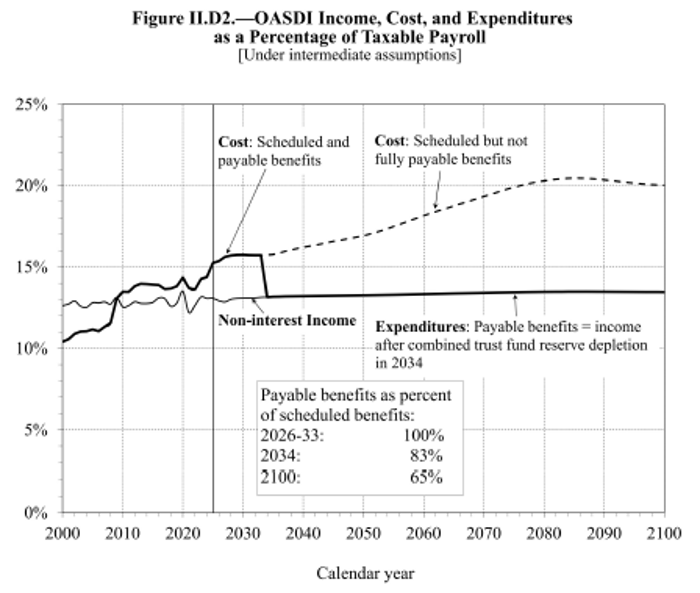
- The program is paying out more than it collects: According to the report, in 2025, Social Security received approximately $1.449 trillion in total income but incurred approximately $1.609 trillion in costs. The resulting $160 billion shortfall was covered by drawing down the trust fund reserves. Those reserves declined from approximately $2.721 trillion at the beginning of 2025 to $2.561 trillion at year-end. The Trustees project that Social Security’s total annual cost will exceed its total annual income in 2026 and every year thereafter. Program costs have exceeded non-interest income since 2010.
- The retirement trust fund is projected to be depleted in 2032: The OASI Trust Fund, which pays retirement and survivor benefits, is projected to exhaust its reserves in 2032. That does not mean Social Security would stop paying benefits. Payroll taxes and other continuing income would still come into the program. However, that income would initially be sufficient to pay only about 78% of scheduled OASI benefits, declining to approximately 62% by 2100 if no changes are made.
- The long-term financing gap has widened: Over the 75-year projection period, the combined OASDI program has an actuarial deficit equal to 4.42% of taxable payroll, compared with 3.82% in the prior year’s report. The estimated 75-year unfunded obligation increased from $25.1 trillion to approximately $29.3 trillion. This estimate does not represent a bill due today. It is the present value of projected future program costs exceeding projected future income.
Why do the actuaries see these as long-term problems?
Fewer workers are supporting each beneficiary
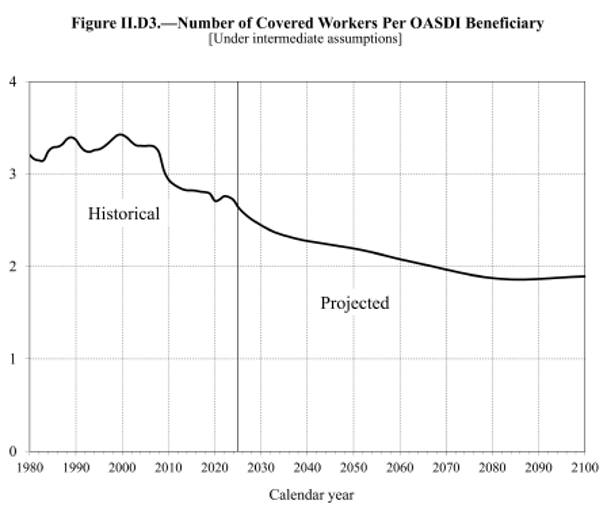
Social Security is largely a pay-as-you-go system: payroll taxes collected from today’s workers fund benefits paid to today’s retirees and other beneficiaries.
In 2025, there were approximately 2.6 covered workers for every Social Security beneficiary. The Trustees project this ratio will decline to roughly 1.9 workers per beneficiary later in the century.
This change is primarily driven by:
- The retirement of the baby boom generation.
- Lower birth rates and fewer future workers entering the system (assumed long-term fertility rate from 1.90 to 1.75 children per woman).
- Longer periods spent receiving retirement benefits.
- Changes in immigration, reducing certain long-term immigration assumptions. and labor-force growth.
Together, updated demographic data and assumptions worsened the projected actuarial balance by approximately 0.44% of taxable payroll.
Delaying action makes the eventual changes larger
The report emphasizes that acting sooner allows any tax increases or benefit adjustments to be phased in gradually and spread across more generations.
For example, restoring 75-year solvency immediately would require changes approximately equivalent to one of the following:

If lawmakers wait until 2034, the Trustees estimate that restoring 75-year solvency would require changes approximately equivalent to increasing the payroll tax rate to 17.30%, reducing scheduled benefits by 28.5%, or adopting an equivalent combination.
What potential solutions does the report identify?
The Trustees Report does not recommend one specific political solution. Instead, it explains that lawmakers have a broad range of options involving increased program revenue, reduced program costs, or a combination of both.
1. Increase Social Security revenue Potential revenue approaches could include:

The report’s numerical examples focus primarily on the amount of additional revenue that would be required, rather than endorsing a specific tax proposal.
2. Modify future benefits
Potential cost-management approaches could include:
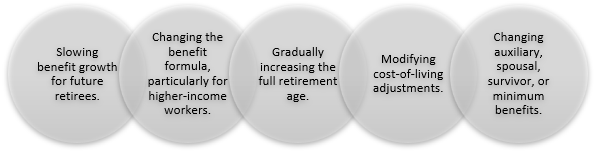
Different benefit changes could affect current retirees, future retirees, or both.
3. Use a combined approach
Most legislative proposals combine several smaller changes rather than relying entirely on a single large tax increase or across-the-board benefit reduction.
A combined approach could spread the impact among workers, employers, higher earners, future beneficiaries, and the federal government. The report also stresses that achieving temporary 75-year solvency is not enough if deficits begin increasing again near the end of the period. A durable reform should place the trust funds on a path toward sustainable solvency beyond the initial 75-year window.
What this means for families
The Trustee’s Report does not say that Social Security is going bankrupt or that benefits will disappear. It says that under current law, dedicated income will eventually be insufficient to pay 100% of scheduled retirement benefits.
For financial planning purposes, families may want to:
- Avoid assuming that every currently scheduled benefit will necessarily be paid in full.
- Build flexibility into retirement-income projections.
- Maintain additional retirement savings beyond Social Security.
- Review claiming strategies as retirement approaches.
- Remember that Congress has several years to act, and that the ultimate changes remain uncertain.
Source: Board of Trustees of the Federal Old-Age and Survivors Insurance and Federal Disability Insurance Trust Funds. The 2026 Annual Report of the Board of Trustees of the Federal Old-Age and Survivors Insurance and Federal Disability Insurance Trust Funds. Social Security Administration, June 9, 2026.